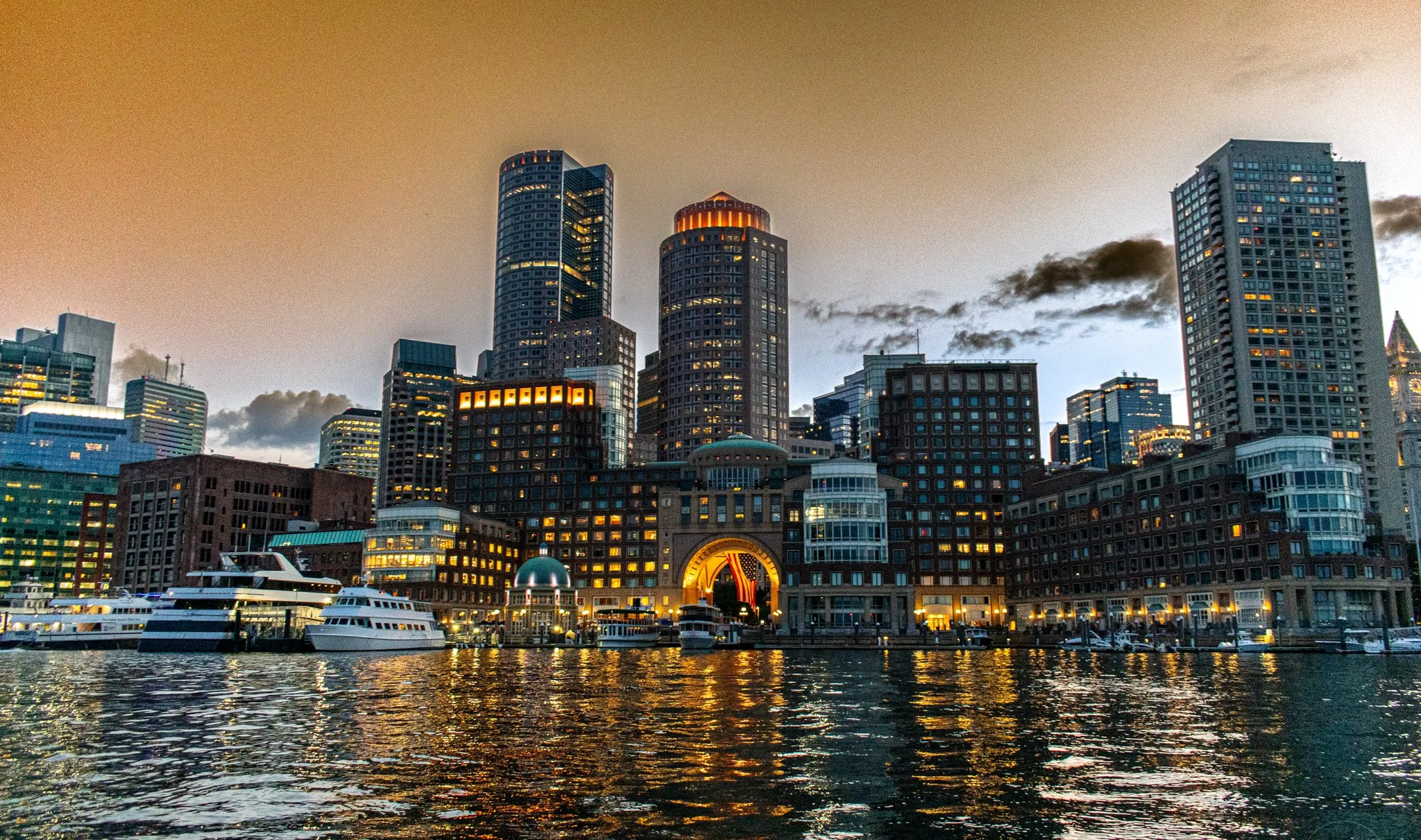
Boston Waterfront
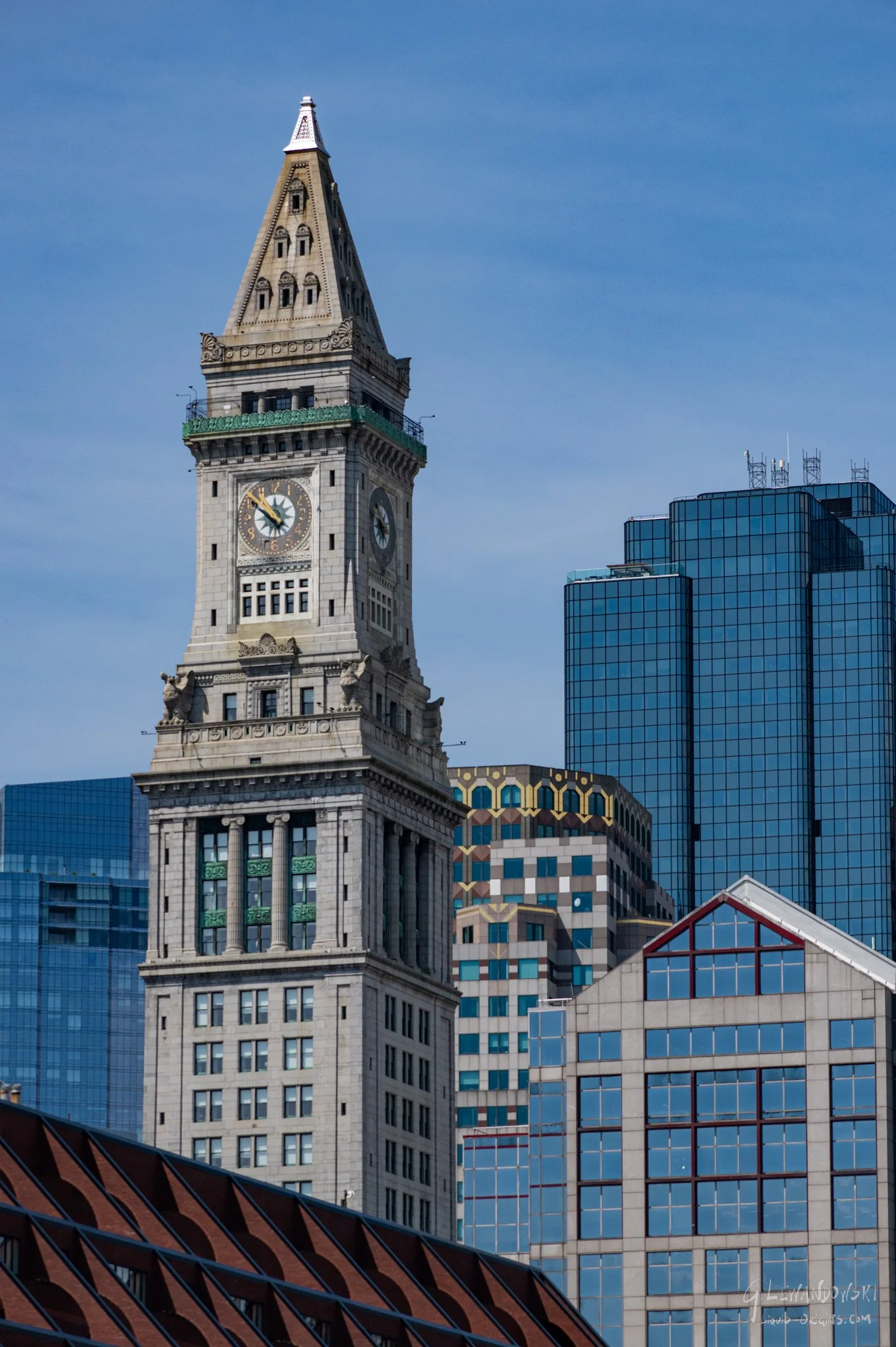
Long Wharf & Customs House
Fanuil Hall
New England Aquarium
Rowe’s Whatf
Northern Ave. Bridge
Boston Tea Party
Summer St. Trolly Disaster
Long Wharf & The Customs House
Long Wharf
Built sometime around 1710-1721, Long Wharf extended from King St. (now State St) from the Fanuil Hall area, back when it was on the water. one third of a mile into the harbor. It was from Long Wharf that British ships evacuated from in March of 1776, after the Revolutionary War. Later that year in July, the Declaration of Independence arrived by ship from Philadelphia in the same place. In the 1700s, the Bunch-of-Grapes Tavern was at the start of the wharf where painter John Singleton Copley grew up, his mother owning a tobacco shop on the wharf.
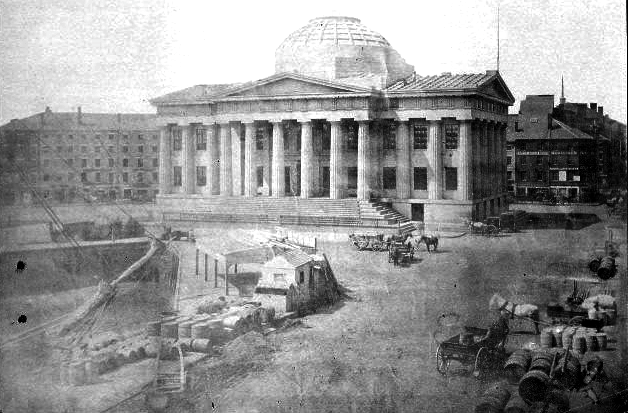
The Customs House Block was a warehouse built directly on Long Wharf in 1848. The block was rented to the government for the use of customs inspectors and for many years the building served as the port’s immigration detention station.
The Gardiner Building (Chart House Restaurant) dates back to 1763 and is the only remaining structure of those built on the wharf in the colonial times of the 1760’s. The pier off Long Wharf was so robust it supported multiple warehouse and storage buildings such as the Gardiner building an Customs House Block.
Finally, at the very end the flagpole is Long Wharf Park, a pavilion built in 1979 that provides both shade and shelter as well as a popular hang out for tourists, students and long time locals. Once you reach the end look down to see the compass rose in the pavement.
QUICK FACTS
The exact length of Long Wharf around the time of construction was 1,586 ft.
Long Wharf had capacity for up to 50 vessels to dock and unload directly into warehouses.
The USS Constitution or “Old Ironsides” used Long Wharf as its primary berth during the war of 1812.
On very high tides, the cellars below the Customs House Block would flood, eventually draining out on their own.
Author Nathaniel Hawthorne worked at the Customs House for many years.
Customs House
The Boston Custom House was used to collect import duties and monitor international trade, serving as a federal government facility for inspections and tax collection related to maritime activities. The Boston Custom House was initially adjcent the beginning of Long Wharf, estimated to have been established in the late 17th century on the waterfront. In 1849 the Federal Government constructed the neoclassical building standing today, the tower being added in 1915. The recorded cost was equal to $1.076 million in contemporary currency. The Customs House had two previous locations before its final State Street location was purchased in 1837
Fanuil Hall
Often referred to as "the Cradle of Liberty" due to its role in American history.
Built in 1742 as a gift to the city by slave merchant Peter Faneuil, serving as a central marketplace and meeting space.
The original design was an open ground floor with the second floor being an assembly room designed by architect John Smibert.
The building was severely damaged by The Great Fire of 1761 but was rebuilt and expanded by John Smibert, then in 1806 Charles Bulfinch expanded the building, adding a third floor and doubling its size.
The Great Fire on Jan 18th 1761 damaged the building so thoroughly that only the brick was left standing.
Quincy Market opened in 1826, it expanded the marketplace cultivating its notoriety for diverse and bountiful foods.
A distinctive grasshopper weathervane sits atop the building, a symbol of Boston's maritime heritage. Grasshoppers are thought to symbolize taking leaps of faith and embracing opportunities, which can be significant in sailing, encouraging sailors to trust their instincts and navigate the unknown.
Theory suggests that Peter Faneuil chose the grasshopper as a nod to the weather vane atop the Royal Exchange in London, a building where many successful merchants conducted business.
The Grasshopper, in a city prone to devastating fires, was designed to act as a fire alarm. In a major fire, a designated watchman would climb into the cupola and ring a bell while simultaneously hanging a lantern or a cloth from the Grasshopper’s antenna. The direction of the antenna, indicated by the weather vane, would then point towards the location of the fire, helping citizens and fire brigades quickly locate the blaze in the often-confusing maze of colonial Boston’s narrow streets.
New England Aquarium
Opened to the public June 20, 1969, with the giant ocean tank being opened in 1970.
NEAQ is a nonprofit research and conservation organization in operation over 50 years.
NEAQ had 12,000 visitors in the first day and 425,000 in the first year.
Myrtle the turtle, the large green sea turtle in the central tank was welcomed in 1970
In 1980, a New England Aquarium research team unexpectedly discovered 25 North Atlantic right whales in the Bay of Fundy. Before that discovery, scientists believed the right whale was nearly extinct. As one of the scientists recalled, “It was like finding a brontosaurus in the backyard.” Later research mapped a right whale migration route from Nova Scotia to Georgia.
The Matthew and Marcia Simons Theatre opened to the public in 2001. A 3-D theater with a six-story flat screen, it was designed to show visitors animals that are too large, too small or too endangered to exhibit live at the Aquarium.
The Aquarium’s right whale research is one of the longest-running whale studies in the world having started over 40 years ago.
The Giant Ocean Tank made of concrete and glass holds 200,000-US-gallon (760,000 L)
Rowe’s Wharf
In 1666 a Fort called "Sconce" or "South Battery” was built at the foot of Fort Hill to protect from invasion with a single gun (cannon).
Not long after Long Wharf was built, in the 1740s, the battery was upgraded to 35 guns for coastal defense.
John Rowe buys the land in 1764, building a wharf that extended a humble distance into Boston Harbor for shipping.
The next big event is the opening of the BRB&L railway in 1875, a ferry service was introduced from Rowe’s Wharf directly to the station in East Boston.
In 1901 the Atlantic Avenue Elevated train line was built, giving Rowe’s Wharf a station to easily access the elevated and subway lines until the eventual closing of both railway and subway in 1938, two years later the BRB&L railway would also close for good.
The modern wharf & building was built in 1987 after years of disrepair, bringing it back to a water transportation hub for the city as well as the iconic arch of the Boston Harbor Hotel.
There’s an observation area on the 9th floor, the Forester Rotunda. It has views in all directions of the city and harbor, and inward down on its own courtyard. Though not advertised, it is usually open to the public.
Its been said that the Boston Harbor Hotel is the only hotel singer Madonna ever stayed at when touring or visiting Boston.
Northern Ave. Bridge
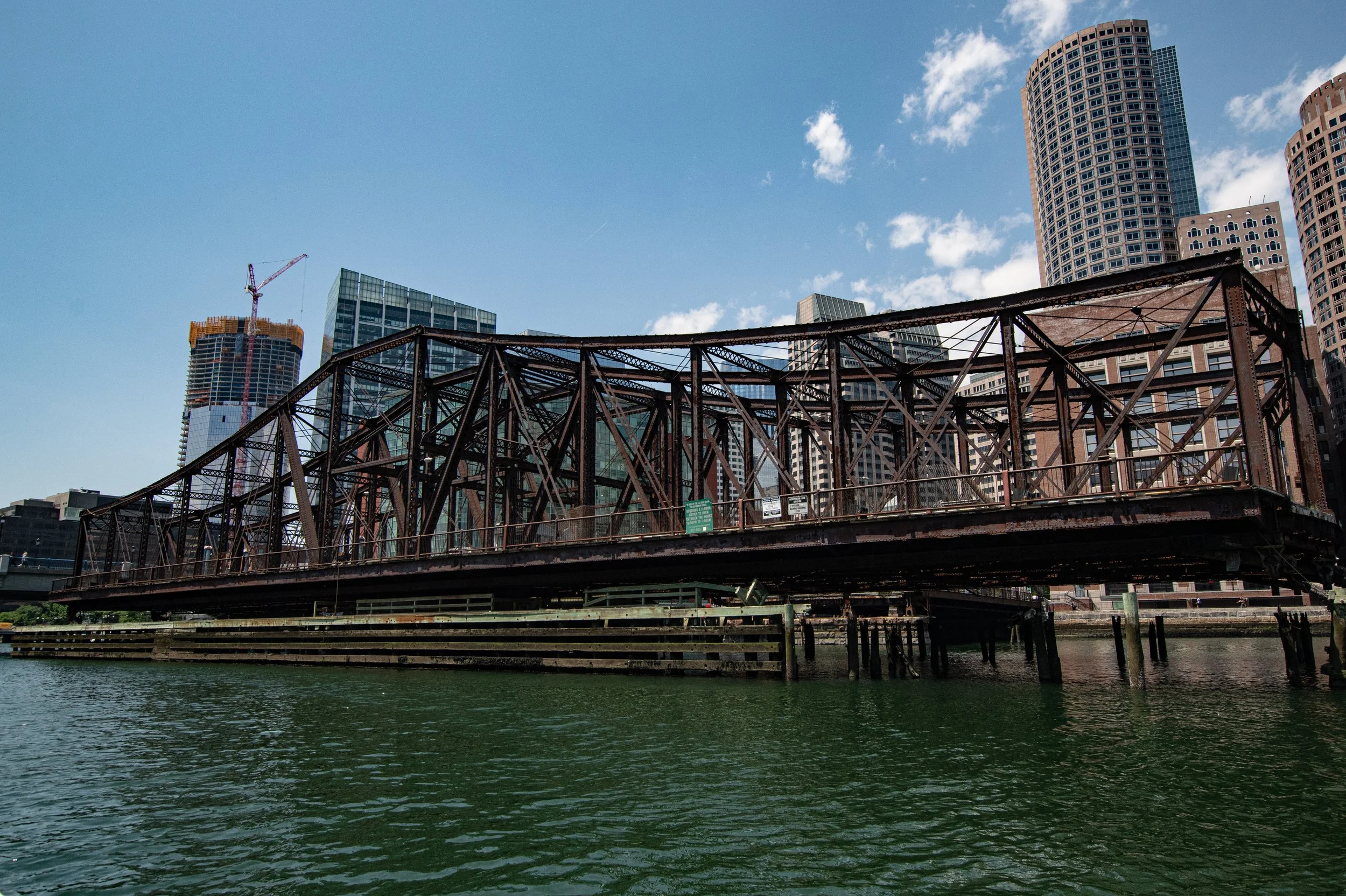
Constructed from 1905 to 1908, the Northern Avenue Bridge was a swing bridge spanning Fort Point Chanel opened October 24, 1908.
The bridge would swing or spin on a pivot point by using compressed air, allowing the temporary passage for ships or boats without clearance to pass the unobstructed waterway.
Decommissioned for vehicle travel in 1997, it was used as a pedestrian bridge until the full closure in 2014 after inspectors found that 13 floor beams were unsafe for even pedestrians.
The total length of the bridge is approximately 640 feet (200 m).
From 1912 to 1948, a firehouse constructed on piers abutted the bridge, serving Fireboat Engine Company 44 of Boston Fire Department. They relocated the station to the North End in October 1948, and the abandoned firehouse collapsed into the harbor in 1968.
In a letter dated October 26, 2015, the Coast Guard informed the City of Boston that the bridge was a "hazard to navigation", due to the risk of it falling into the Fort Point Channel, and requested removal of its most vulnerable portion.
The removal process began with filing detailed permitting applications with local, state and federal agencies, including the Massachusetts Historical Commission (MHC), MA Department of Environmental Protection (DEP), the Boston Conservation Commission and the US Army Corps of Engineers (USACE), and others.
On January 20, 2016 The Boston Globe and Boston.com reported that the City of Boston would spend $100 million to reopen the bridge, as part of its agreement with General Electric to establish a new location. The following day, the Globe reported that the bridge would instead be removed, and possibly replaced.
Spring 2016 the City of Boston and the Boston Society of Architects held an "ideas competition" for reconstruction or replacement brainstorming.
Then in December 2019, city officials announced that the bridge would be rebuilt for use solely by pedestrians and bicyclists, the design was expected to be finalized by the end of 2020 and construction to begin in 2021 but the COVID pandemic and a Mayoral resignation put a hold on the process.
As of March 2025, Boston's public works department "is advancing plans to break it apart and load the pieces onto barges to a waterfront staging area... for disassembly and paint removal.
Boston Tea Party
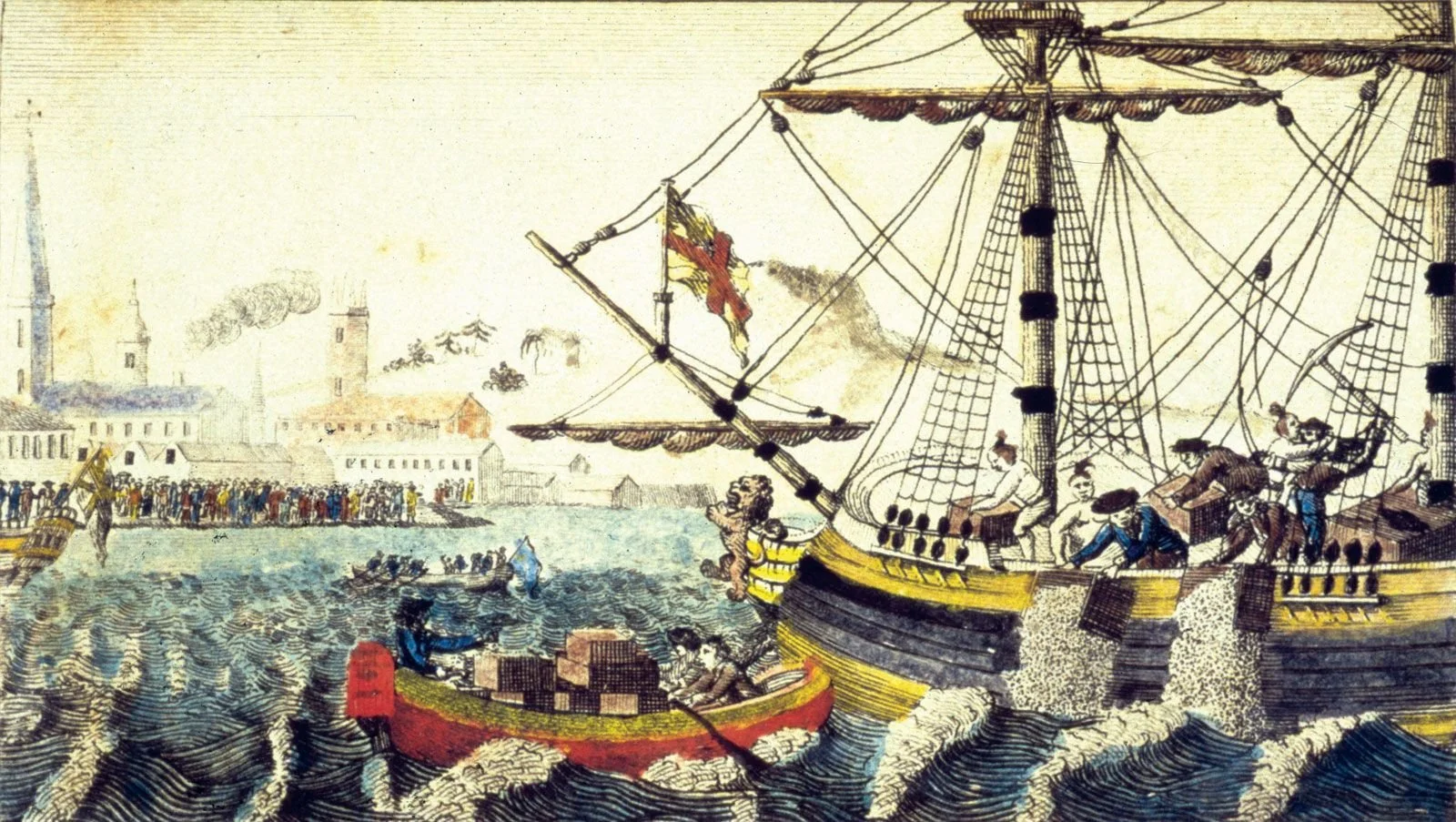
The Boston Tea Party was one of the oldest and most famous protests in the country, dating back to December 16, 1773. American colonists disguised as native Americans and led by the Sons Of Liberty dumped 342 chests of tea into the harbor from the ships of Britain’s East India Company. The event was partially in protest of taxes brought forth with laws such as the Tea Act and what was essentially a corporate bailout. The taxes were imposed on the colonists without a representative at Parliament to pay off Britain’s surmounting debt. On the other side of the business, for years the East India Company was required to ship its tea to Britain and pay a tax before selling it in the colonies in exchange they had a monopoly on tea. The tax paid by the East India Company made its tea more expensive in America than tea smuggled in merchants and traders. When the East India Company ran into financial difficulty, Parliament offered a bailout deal. The company could keep its monopoly and export tea directly to America without paying the tax in Britain, however the colonists would still pay the British tax. This made the East India tea cheaper than Dutch imported tea and established the principle that America was subject to British taxes. This made small, independent tea merchants find it difficult to compete with the East India Company as well as rile up the colonists who refused to pay the British tax.
The Sons of Liberty, a group of colonial merchants, tradesmen and revolutionists had already been founded over the protest of numerous forms of taxes arising. They held meetings rallying against British and protested the arrival of East India Company ships carrying tea. By December 16, 1773, three ships, the Dartmouth, Beaver and Eleanor; had arrived with tea from China. The morning on which the last of the three arrived in port, thousands of colonists convened at the wharf and its surrounding streets, meeting at the Old South Meeting House where a large group prompted to refuse to pay taxes on the tea. The ultimate decision being that they would not allow the tea to be unloaded, stored, sold or used. Governor Thomas Hutchinson refused to allow the ships to return to Britain and ordered the tea tariff be paid and the tea unloaded however, the colonists refused and Hutchison didn’t offer compromise. That night, over one hundred men disguised themselves in Native American garb, boarded the docked ships and threw 342 chests of tea into the water before morning light.
Retribution: In response, King George III and British Parliament passed the Coercive Acts (later known as the Intolerable Acts), which:
Closed Boston Harbor until the tea lost in the Boston Tea Party was paid for
Ended the Massachusetts Constitution and ended free elections of town officials
Moved judicial authority to Britain and British judges, basically creating martial law in Massachusetts
Required colonists to quarter British troops on demand
Extended freedom of worship to French-Canadian Catholics under British rule, which angered the mostly Protestant colonists
Quick Facts:
There was 90,000lbs (45 tons) of tea Chinese green tea dumped into Boston Harbor.
46 tonnes of tea worth more than £9659, worth $1.7 million in today’s dollars.
Ben Franklin offered to pay for the damages caused by the Boston Tea Party under the condition that the Brits re-open Boston Harbor but the monarchy refused.
It took over 100 men nearly 3 hours to empty all the tea into the harbor.
No one was hurt, and aside from the destruction of the tea and a padlock, no property was damaged or looted during the Boston Tea Party. The participants reportedly swept the ships’ decks clean before they left.
Most participants in the Boston Tea Party were under the age of 40, and 16 of them were teenagers.
Many colonists, including wealthy merchants such as John Hancock and Samuel Adams protested taxation without representation had interest to protect their own tea smuggling operations.
The Boston Tea Party wasn’t the lone protest on the eastern shoreline. There were at least 10 other uprisings that went from Philadelphia down to Charleston.
John Singleton Copley, the artist, tried to work out a compromise with the Sons of Liberty. His father-in-law, an East India merchant, needed the tea.
Some chests of tea weighed up to 400lbs.
The destroyed tea could have brewed 18,523,000 cups of tea.
Summer Street Bridge Disaster
November 7th, 1916
On a warmer than normal fall evening in part of Southie, now Seaport, Bostonians would be completely shocked and horrified at the scene to unfold at the Summer Street Bridge. The energy was heightened in the city, the red sox had come off their second straight world series championship and the presidential elections were being held. President Woodrow Wilson was being challenged for the presidency in an extremely tight race. It was just past 5:30pm by the South Boston shipping docks largely occupied by warehouse and industrial businesses. Among the pedestrians, horse drawn carts and occasional automobiles, Trolly no. 393 departed the Elevated Railway’s P Street location with 62 passengers on board, bound for downtown Boston via the Summer St. bridge. With so many making their way to downtown Boston to check the latest election results trains and trolly’s were operating closer to capacity than empty, with standing room only. The BERy trolly’s had 37 seats, some recall them being packed with up to 90 or more riders but 62 was still quite full and uncomfortable. This trolly was an additional service between the main service trolly’s to help with the excess of passengers. Motorman Gerald Walsh picked up his last passenger only around seventy-five feet from the start of the Summer St. bridge as conductor George McKeon took tickets at the back of the trolly.
Walsh started to pick up speed and approach to the retractile drawbridge, a rare type of bridge designed to pull the spans of street sections diagonally on rails for ships to pass. While open, a gate and flashing lights were lowered in place as a warning and deterrent for land based traffic. Approaching the bridge, for some reason Walsh did not process that the bridge was opened and gates lowered; the road was gone and by the time he reacted it was too late. The brakes were applied but were little help, Trolly no. 393 crashed through the gate and over the edge, plunging into the icy waters of Fort Point Channel. Gerald, George and an unidentified female passenger had enough time to react and leap from the train. Walsh still ended up in the water and was the first rescued sustaining cuts and bruises but nothing more noted. The female passenger was apparently in such shock over the whole near death experience she got up, dusted herself of and ran away screaming, never to be identified. The splash was deafening followed by loud gurgling, then gave way to bubbles and ripples as the trolly car sank 30ft/9m to the muddy bottom below. A few lucky passengers at the rear were able to jump off before the trolly hit the water, left floating in the chaos. Most passengers remained trapped inside, pushing and clawing to escape the broken windows and openings. The few who were able to make it out of the trolly and to the surface only found another battle trying to stay afloat with saturated woolen winter coats, clothing and shoes. Luckily there were some boats nearby who were able to assist the struggling, frigid survivors. Its reported that thousands of people flocked to the scene some to help and others attracted by gruesome curiosity or seeking reassurance their loved ones were not among the dead. It soon became clear there would be no more survivors, firemen rescued two bodies around 7:00pm before Navy divers and tug boat cranes were brought in with giant floodlights to illuminate the channel. They needed to remove the dead before lifting the trolly itself so starting at 10 c’clock the Navy divers began with the first recoveries. In total, 46 people had perished and been recovered, one being 19 year old Elsie Wood who was not found until washing ashore six months later.
In the investigation and trial that followed a year later, Walsh would be held at fault and arrested on charges of manslaughter. In the findings Walsh had failed to stop at the posted sign, but noted that such signs were hard to see and that many drawbridges lacked them entirely. Beyond this Walsh and Gerald were both familiar with the area but being as that had been an extra service for that day, it was not their normal, well known route. The bridge operators claimed the red lantern used as a required warning was hung in place on the bridge, while Walsh claims it wasn’t. Some brought into question and found suspicious how the lantern was eventually found hanging, undamaged, directly over a section of gate with bent and mangled upright iron posts, suggesting it was placed after the accident. There was reportedly also a police officer who walked the bridge on his beat and said the street light had twice gone out that past week but flickered on when he had kicked it. Some witness suggested Walsh was driving at an unusually fast speed while McKeon testified he was driving normal. Walsh was eventually declared not guilty but would never run a street car again. He enlisted and fought in WWI, returning a decorated soldier but still never recovered, he reportedly suffered from depression until a heart attack took his life at age 41. McKeon also fought in WWI but died in combat July of 1918, after becoming under attack near the Marne River in the Champagne region of France.
Trolly no.393 was recovered, repaired and put back into service to the dismay of many, nicknaming it the “death car” or sometimes “ghost car” many refused to board it. Given the lack of popularity and hesitation of riders, it was eventually removed and sent to scrap. After WWII nearly all the tracks had been removed or paved over and the Summer St. route itself dissolved by June 1953.